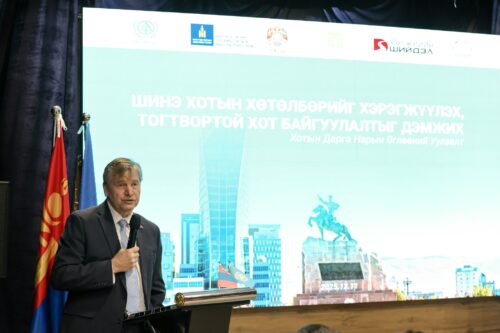
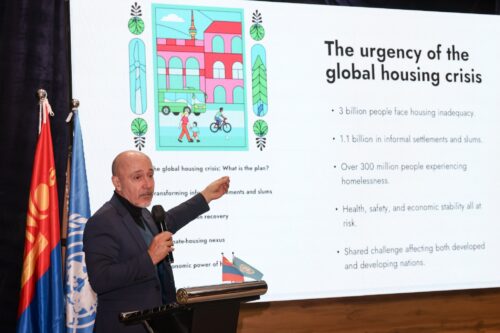
A breakfast meeting titled ‘Implementing the New Urban Agenda and Promoting Sustainable Urban Development’ was successfully organized under the Adaptation Fund–supported Ger Community Resilience Project, implemented by UN-Habitat in partnership with Development Solutions NGO.
The meeting was honored by the presence of Mr. Jaap van Hierden, United Nations Resident Coordinator in Mongolia, and Mr. Roi Chiti, Regional Human Settlements Officer for Asia and the Pacific of UN-Habitat, who delivered opening remarks. Approximately 45 participants attended the event, including representatives from the Ministry of Urban Development, Construction and Housing, the Ulaanbaatar City Administration, and city governors and officials from Darkhan, Erdenet, Chinggis, Sukhbaatar, Bulgan, Tsetserleg, Zuunkharaa, Zuunmod, Khunnu, and Kharkhorum, as well as representatives from other relevant sectors.
During the breakfast meeting, participants exchanged information and experiences on key topics related to aligning sustainable urban development and climate change adaptation policies and planning at the urban and settlement level. Mr. Rooy Chitty delivered a comprehensive presentation on UN-Habitat’s global, regional (Asia–Pacific), and Mongolia-specific activities, as well as the objectives and key initiatives of the 13th World Urban Forum.
In addition, Dr. Altanbagana M, an expert and a project partner, presented on the progress of Mongolia’s reporting on the implementation of the New Urban Agenda (NUA), adopted at the UN-Habitat III Conference. She emphasized that the national report is based on an assessment of 47 indicators and highlighted the importance of submitting Mongolia’s report to the United Nations within 2025.
Furthermore, Dr. Dagvadorj D leader of the Climate Change and Development Academy delivered a presentation on Mongolia’s National Adaptation Plan 3 (NAP 3) and Nationally Determined Contribution 3.0 (NDC 3.0), focusing on how these policy frameworks can be integrated into urban and settlement-level planning, and how climate adaptation measures can be incorporated into city development strategies. This was followed by an active discussion among participants.
During the discussion, researchers and experts underscored the critical importance of reliable local data from provincial and secondary cities—beyond the capital—in ensuring the quality of policy reporting and assessments. Representatives of participating cities noted that many municipalities have already begun preparing or updating their urban planning and development documents, and emphasized that the knowledge and insights gained from this meeting would provide practical support for their ongoing work. Participants also expressed strong interest in receiving methodological and technical guidance from UN-Habitat going forward.
Following the event, UN-Habitat proposed the establishment of a joint communication and collaboration group to facilitate continued information sharing and cooperation among participants. In addition, a proposal was put forward to enable Mongolia’s cities to participate as a broad and coordinated delegation in the World Urban Forum (WUF) to be held in Baku, Azerbaijan, in 2026.
This breakfast meeting marked an important step toward strengthening cooperation among cities, aligning climate adaptation and sustainable urban development policies, and deepening multi-stakeholder collaboration for resilient urban futures.